$$3.1415926 < \pi < 3.1415927$$
How did ancient mathematicians comes up with such estimates of π? There are various histories but one quite interesting one is how Greek and Chinese mathematicians seemed to come up with the same concept independently.
The circumference of a circle is π times the diameter. The idea is to work with polygons inscribed within a circle that they know how to compute the perimeter of. The more sides that the polygon has, the closer they can get to the real value of π. See diagram.
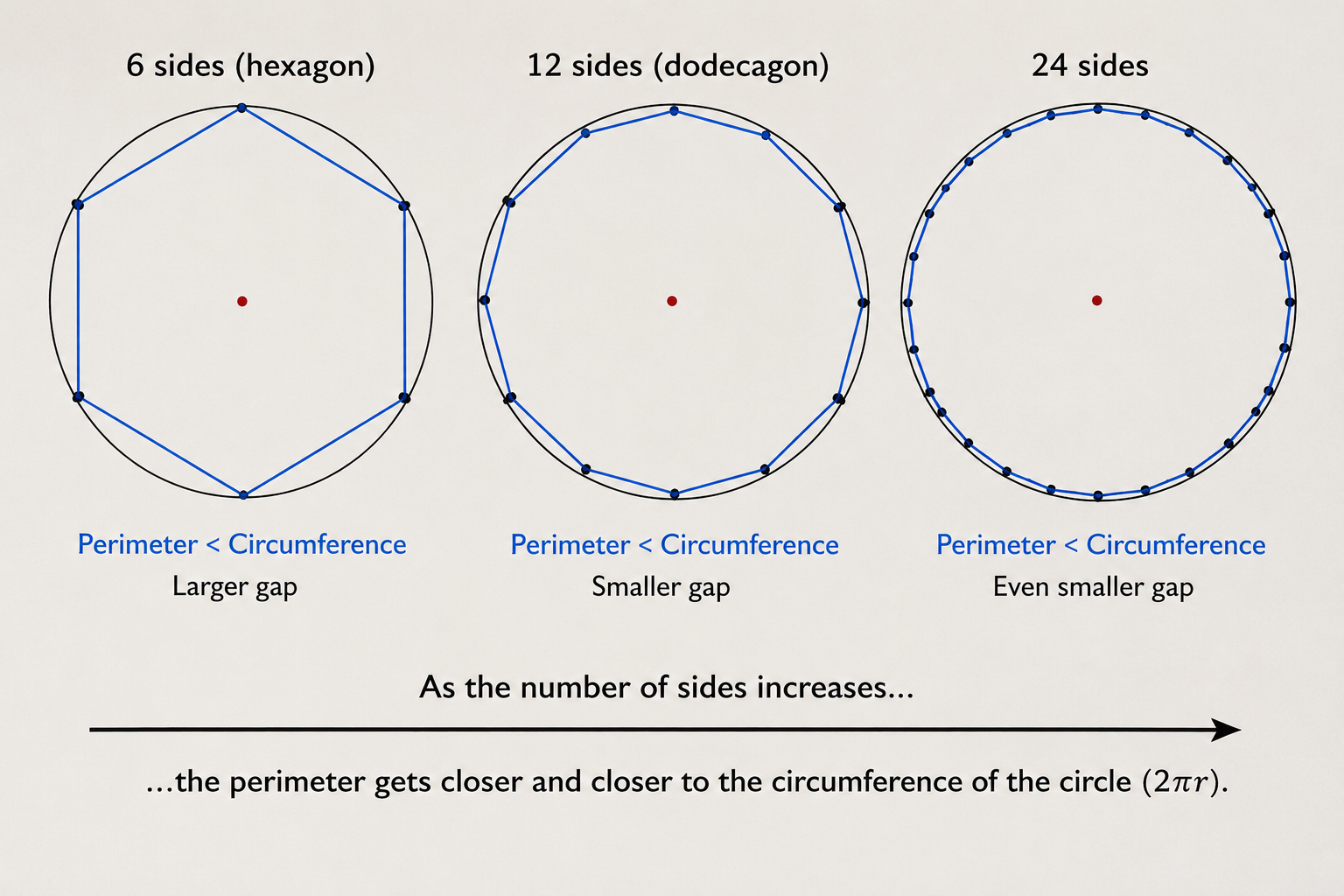
Alternatively to the circumference one can estimate the area of the circle, which is the product of π times the radius squared. The same idea works.
History
Archimedes of Syracuse was the first to use the technique with circumference, around 250 BC. Archimedes started with a hexagon and doubled the number of sides over a few iterations, eventually working his was up to a 96-sided polygon. This gave a lower bound for π. Similarly, he cicumscribed polygons around the outside of the circle to get an upperbound. From these calculations, Archimedes arrived at the estimate:
$$ \frac{223}{71} = 3.1408... \lt π \lt \frac{22}{7} = 3.1428... $$The result of Archimedes did not seem to be known in China, where they usually estimated π to be 3. There were some mathematicians who had done better than that, but the first big step forward came from Liu Hui sometime in the 3rd century. Conceptually, Liu Hui's work was similar to that of Archimedes, but the calculations were quite distinct. For one, Liu Hui worked with the area of the circle rather than the circumference. Also, Liu Hui did not circumscribe polygons to get an upper bound, but instead developed a way of estimating the error in the calculation to get the upper bound. After working his was up to a 3,072 sided polygon, the following estimate was obtained:
$$ 3.141024 \lt π \lt 3.142704 $$Two centuries later, Zu Chongzhi extended Liu Hui's work, going up to a 12,288-sided polygon. Zu Chongzhi's work was documented in a text called Zhui Shu (綴述, "Methods for Interpolation"), which has been lost. Historians believe that this book had advanced algorithms to compute the estimate of π. Additionally, Zu Chongzhi introduced the concept of Milü Fraction (密率) to find the best rational approximations of π, coming up with \(\frac{355}{113} \approx 3.1415929 \) which is accurate to 6 decimal digits. Zu Chongzhi's upper and lower bounds for π were:
$$ 3.1415926 \lt π \lt 3.1415927 $$Show the math
Let's do an example with a 12-gon having radius R.
The image below marks the 12 vertices of the polygon, which are equal distance apart.
The letter O is used to mark the origin.
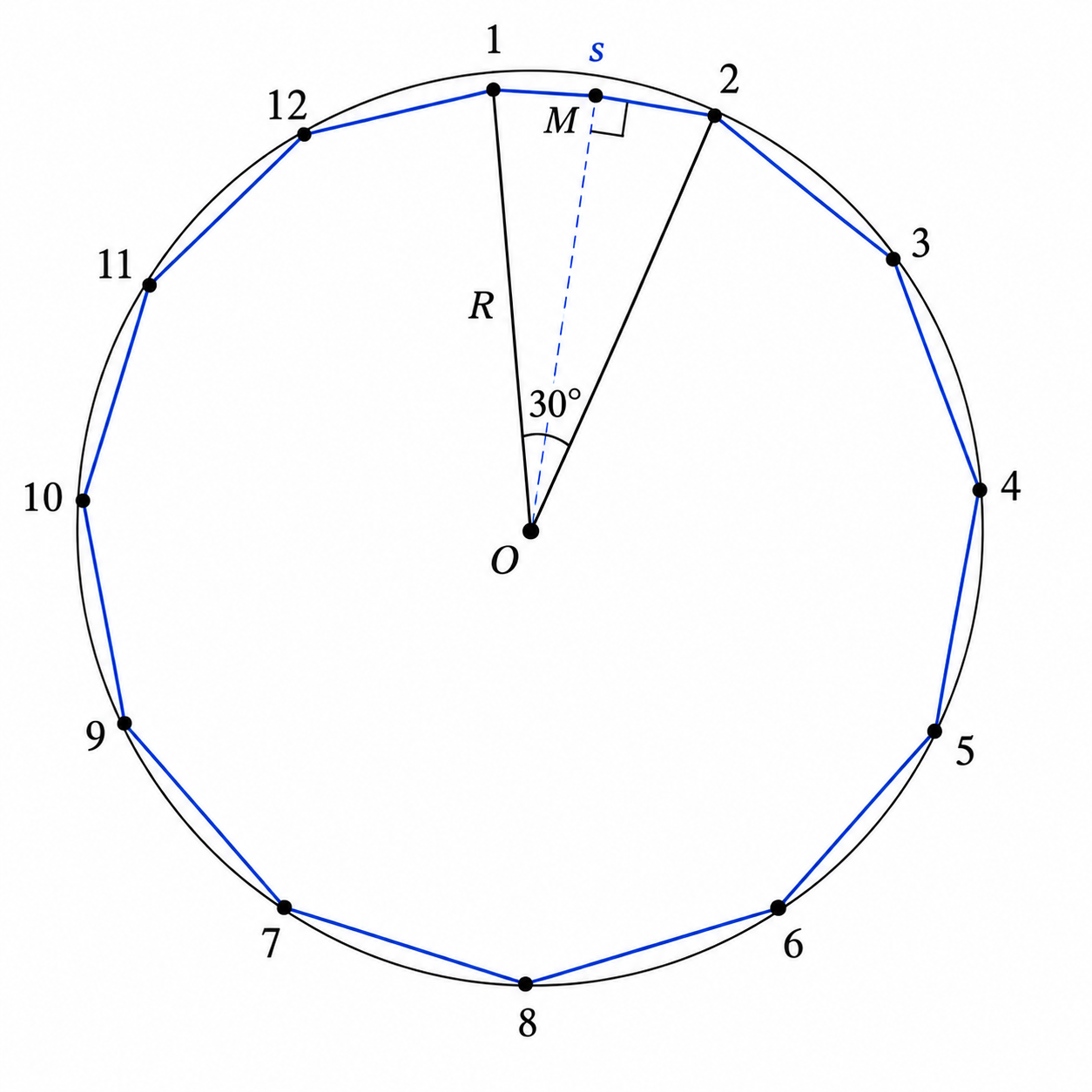
The side between vertices 1 and 2 is marked as s.
M is the midpoint halfway between 1 and 2.
A whole circle is 360°, so one twelfth of
the circle is 360° / 12 = 30° and the angle
∠ROM is half of that, 15°.
The way we would work out the length of side s today is
with trigonometry.
We know that the sin of an angle is equal to the
length of the opposite side (s/2) divided by
the length of the hypotnuse (R).
So:
Since the polygon has 12 of these sides, its perimeter is 12s
which is slightly less than the circumference of the circle, 2πR.
Therefore:
$$\pi \approx \frac{12s}{2R} = 12\sin(15°) \approx 3.1058$$
Generalizing this to an n-gon, the formula would be:
So we can estimate π by putting in larger and larger values of n.
But this is not what the ancient mathematicians did because they did not
yet have such tables for sin and other trigonometric functions.
Instead, they found that they could compute the
perimeter of a 2n-gon from an n-gon
simply by using the Pythagorean theorem: See the references below for more details.
Where to Learn More
- Finding Pi by Archimedes' Method: YouTube video from MathWithoutBorders
- How did Archimedes ACTUALLY calculate pi? YouTube video from Ciaran McEvoy
- Measurement of a Circle — Wikipedia (Archimedes' original method)
- Liu Hui's π algorithm — Wikipedia (the error-bounding inequality)
- Zu Chongzhi — Wikipedia